Friday, June 5, 2020

VALE JON HELLEVIG By Ghassan Kadi 4 June 2020

Ghassan's tribute to Jon Hellevig, our very dear friend.

Vale Jon Hellevig

by Ghassan Kadi for The Saker Blog

When our friend The Saker asked if either Intibah or I would like to write a necrologue for Jon Hellevig, we both felt we couldn’t give the request enough justice, because we didn’t know Jon enough. But as I decided to take the lead here and write it in my name, with Intibah’s help, I realized that I knew Jon enough to honour his legacy by relaying my short sad and sweet experience with him to my readers.

Jon was initially a Facebook friend whom we ‘met’ over the fight for Syria’s sovereignty and independence. When Intibah and I decided to visit Moscow in the spring of 2015, arrangements were made to meet in the flesh. And after a long and tedious flight from Hong Kong and a taxi trip to the hotel, Intibah noticed him sitting in the lobby waiting for us.

As he stood up to shake our hands, I felt dwarfed by this imposing gentle giant as my height could hardly reach his shoulder, and quickly, we took our luggage to the room, put a band aid on our flight fatigue, and went out with him for a walk around central Moscow. We had a wonderful evening together and he insisted to pay for dinner.

Jon was excited not only to see us, but it was the first real warm spring day in Moscow. The traditional Russian winter lockdown locked up his free spirit and made him feel imprisoned in a cage, as he put it. He loved spring and what it symbolizes, because Jon was full of life, full of ideas, positivity, and wishes for a better world.

The last thing I imagined back then was that only five years later I would be sitting down writing his eulogy.

In writing this, I don’t only want to mark my respect to a dear friend, but I also want to express the grief I feel, as this may help me self-heal and fill that deep sinking hole that his untimely death has created in my heart and soul.

For more than the five years since we met in the flesh, Jon was my mentor even though he was seven years my junior. I looked up to his vast knowledge and wisdom at many levels. He was a deep thinker with an amazing intellect, and extremely good with numbers when it came to economics; the real economics of the world. He was also Intibah’s mentor on ‘forensics’. Intibah’s unofficial professional title is the ‘forensic journalist’, and she and Jon worked together on many ’investigations’.

Jon loathed injustice, spoke strongly, fearlessly and vehemently against oppressors of all sizes. He spoke so openly that he lost many ‘friends’ along the way because diplomacy was not a forté with which he was blessed. Quite the contrary in fact, if he thought one was stupid; he called him stupid, moron, idiot, and he did not shy away from using more colourful language, and often made me laugh as he did; and this was because when he resorted to such language, it was justified and in him doing so, he expressed my angry side that I often keep the lid on.

He loved Russia. He adored Russia and chose it to be his home even though he was Finnish. He travelled extensively in Russia whilst he lived in Moscow, he absolutely loved the Black Sea region; especially Sochi. He made many trips to Donbas to see what was happening on the ground with his own eyes. And a few years ago, he met another great friend in India, Arun Shrivastava. Sadly, Arun passed away not long after leaving behind an important manuscript he wrote on the role of nefarious NGO’s. Intibah and I worked with Jon trying to salvage his work and have it published, but the single original copy of that work instead reached the hands of a former ‘friend’ who promised to have it translated to many languages and published. In hindsight, all he actually wanted to do was to put his filthy hands on it and make sure it never sees the light. That was such a disappointment for Jon and us. It is such a travesty that Arun’s work was confiscated by that slime of a human… I seem to be picking up some of Jon’s vocabulary already.

This year, sweet Jon did not get his spring. The COVID-19 lockdown locked up his heart and mind and sent him into deep and agonizing depression. For many people, this is something they can tolerate, but not for a soul that thrives on light and freedom. The flower was not allowed to blossom. Flowers do not grow in the dark.

Jon was no stranger to depression, and before his heart stopped, Intibah and I felt from his writings that he wasn’t well. We spoke to him on the 17th of May for over an hour. He was touched to hear our voices and to know that we cared for him and loved him. His pain was impossible to hide, but so was his hope and intention to come and visit us soon when this kerfuffle was over.

In the conversation, he made reference to similarities between himself and Kafka. I didn’t know much about Kafka and I am not going to pretend to be an instant expert on him after a quick Google job. But that analogy reminded me of my mother who lived the pain and suffering of French poet Lamartine for her entire life. And speaking of Lamartine, how can one forget Edgar Allan Poe? Such is the case of gentle souls.

We were planning to speak to him again, but didn’t want to inundate him with calls enough to make him feel we were worried and raise his concern. In hindsight, we wish we did.

We still don’t know where and when Jon’s body was ‘discovered’ as he lived alone. What we do know is that he died on the 26th of May of a heart attack at the prime age of 58 with still so much to give.

It is such a tragedy to realize that dear Jon was an inadvertent victim of COVID-19. The lockdown stifled his free spirit, and his heart gave up, because Jon lived up to his principles in every part of his body and mind. Pretence was not in his dictionary.

Jon my friend, forgive me for I cannot attend your funeral, but with these words, I let you rest in peace. Farewell.


LEBANON'S PATH OF CORRUPTION AND DESTRUCTION By Intibah Kadi 2 June 2020

LEBANON'S PATH OF CORRUPTION AND DESTRUCTION 


An article I've been thinking of writing for a while as the situation and extent of suffering in Lebanon and the flow on effect on Syria seems to be off the radar due to other serious issues around the planet.

http://thesaker.is/lebanons-path-of-corruption-and-destruction/

Lebanon’s path of corruption and destruction

By Intibah Kadi for the Saker Blog

With COVID-19 capturing almost total world attention, eyes are not focused on the numerous alarming events occurring around the world. In Lebanon, a disaster has been unfolding; a place in the long past described as the “Land of milk and honey” and even when one now wanders the hills, it still rings true to an extent. The fact is that now the ordinary people, including much of the middle classes, are facing impending food insecurity and even starvation. Even those who normally write of events in the region, including those “Syria watchers” who enter Syria via Lebanon, seem not to have covered this emerging crisis, notwithstanding the fact that the COVID-19 related restrictions would have played a part in that. For Syria, the flow on effect from this looming crisis is very serious.

Ghassan Kadi, alarmed at the developments in Lebanon in the latter half of 2019, just prior to the financial sector collapse which rapidly plunged the country into an impossible and perilous position, wrote a series of articles on how Lebanon had arrived at such a point.

The last straw was the collapse of the financial services sector. It was the only institution that remained well intact after the long years of the Civil War, admittedly boosted with much war monies.

In the link above, the history of how Lebanon came to be separated from Syria is explained. There was no excessive wealth lying around in those early decades of the new State. However, with its unique stature as the only Arab state with a Western-oriented affiliation , by the 1950’s and 1960’s Lebanon exploded into a vibrant, wealthy hub that provided many service and professionals required by the newly wealthy oil kingdoms in the Gulf and Saudi Arabia, from doctors, teachers to international banking and transport infrastructure and a place to have fun.

Business and wealth also flowed in from Syria from those not wanting to partake in Syria’s move towards socialism. Lebanon inadvertently became a ritzy, sophisticated, must-go-to tourist destination, and not just for those from the new oil-rich states, but also for European and American tourists. Money began to pour into the financial services sector, with the national bank bearing the name at the time as the “Banque de Syrie et Liban” (i.e., Bank of Syria and Lebanon), there was not much in this name to reflect the independence or success of Lebanon at any level. By the time “Banque de Liban”, came to be in the mid-late 1960’s, Lebanon’s financial prowess had already made its international mark.

Despite 15 years of civil war ravaging Lebanon between 1975 to 1990, where the country’s most valuable achievements vanished before one’s eyes, just one sector remarkably remained least devastated; the financial sector. For over 27 years since the war ended, the Central Bank experienced continuity of leadership from just one Governor, regarded highly and talked-up by the world banking community, and such resilience was interpreted as a bank that is a safe haven for investors. [3] Large sums continued to pour into it from the sizeable proportion of Lebanese working as expats, particularly in the Gulf and especially in Saudi Arabia. These expats, tended to send their savings back to these “safe” banks in Lebanon or to their families to manage, not considering Saudi banks as an option for a number of reasons, including lack of trust and fear of policies being suddenly implemented to confiscate their hard-earned savings or restricting its transfer.

With the financial sector of Lebanon’s demise this year, literally hundreds of thousands of Lebanese expats who have worked for decades abroad, with many of them ready to retire, or having recently retired, knowing their future depends of that nest-egg they built up all their lives, the unthinkable happened; their nest-egg is no more.

Who would have thought this possible that the Lebanese financial sector could possibly go under?

The common practice has been that deposits to the numerous banks in Lebanon are then reinvested in the Central Reserve Bank. The situation now is that the Central Reserve Bank is empty because it has been raided. Actual deposits have been siphoned out resulting in the massive devaluation of the Lebanese Lira (LL). We are talking about 800 billion dollars according to this link and several others.

It is a huge figure for any country, let alone a small one like Lebanon. The Prime Minister has squarely put the blame on the Governor of the Central Bank, but there are fingers pointing at many government officials, from all different parties; this one is accused of stealing ten billion, this other one accused of stealing five billion and on it goes. How does one prove who stole what and how can it be recovered?

On the ground the situation is dire. When the Central Bank could no longer hide the facts, the bank commenced limiting withdrawals. No individual, no business, no government department; no one, could withdraw more than a small unsustainable monthly amount of US dollars. The USD in Lebanon is the commercial currency, if not the actual every day currency. Eventually, no US dollars were allowed to be withdrawn and, even if one were to have a USD account, one only is given LL. The current currency exchange situation of USD to the LL is anywhere between 30 to 40% less than its market rate. There is no limit to taking LL out, but they are worth so little. The population is unable to sustain itself, businesses are no longer viable, no one can pay bills, let alone possess the ability to pay staff and workers, or buy materials for continuing the business or for manufacturing, and trying to send money to Lebanon, of course not through banks, is a trial with the recipient being paid out in LL. Vendors trying to operate in this fast, typically downwards moving spiral, try to protect themselves from the falling LL and inflate their prices. Desperation has set in en-masse, even among formerly highly successful, educated Lebanese. Daily painful situations arise, leaving one at a loss as to how to provide assistance.

Can anyone imagine the domino effect of something like this when vendors resort to such tactics of self-preservation and its impact on the wage earner who is lucky to even receive a partial wage now?

As for long-suffering Syria, money destined for ordinary Syrians since the sanctions, usually came in via Lebanon. Apart from the long years of the war, the people’s suffering has been exacerbated by ongoing, crippling sanctions, the situation of COVID-19 with its restrictions and associated financial fall-out, Lebanon’s financial sector collapse, a dramatic increase in poverty in both countries, an end to employment opportunities in Lebanon and, the final straw of not being able to access funds sent to Lebanon, all leaving Syria in a disastrous and vulnerable situation.

Thanks to the crippling, illegal, immoral and inhumane sanctions placed on Syria by the West, one cannot transfer money to Syrian banks. Services like Western Union in Syria are rendered untenable, due to the massive difference in the formal price and the market price of the US dollar, where two-thirds of the money is lost. In Syria, the official rate is 600 liras for one 1 USD. But the market rate is approx. 1600 liras to 1 USD. Seeing the forced smiles on the faces of beloved ones, trying to hide the demise of their enthusiastic, ever hopeful youthful approach to life, and a sense that they have given up before their lives really began to take off, is painfully etched in the heart and psyche of this writer.

Re-visiting the subject of a lack of focus or perhaps even concern on the part of some“Syria watchers” who rely on Lebanon and kind people there for their transit to and from Syria, it is probable that they don’t appreciate the depth of the intricate relationship between Lebanon and Syria. Despite the fact that Syria was partitioned into these two separate state entities, they kept relying on each other for many reasons. Lebanon always relied on Syria for the supply of many agricultural goods, fresh produce, meat, an array of manufactured goods as well as services and cheap labour. Syria proudly has preserved ancient crafts and skills and their artisans have been employed in Lebanon in the furniture, jewellery making businesses and other industries.

Syria relied on the Lebanese banking system and especially in times of sanctions. If there are indeed “silent” and ”covert” sanctions on Lebanon as Ghassan Kadi suggests below, then it means there are additional sanctions on Syria. With the situation of the banking crisis in Lebanon currently, Syria’s financial lifeline has been cut off.. A route to Cyprus exists for banking, but it is expensive, and besides, particularly if one is running a business and have staff, how would one physically bring that money (USD) back into Lebanon and also Syria? There are clearly different tiers to this alleged “covert” and “unspoken” American sanctions on Lebanon. Their double effect, that being also on Syria, no doubt brings delight to Israel and the US.

There is more to this all than corrupt officials raiding the bank, allowing this one remaining major institution to collapse so monumentally. According to Ghassan Kadi, a number of issues are at play and one of them is “… the silent, covert American sanctions against Lebanon, in an attempt to push Hezbollah out of participating in the government.” The US delivered numerous subtle messages to Lebanon about consequences if they fail to curb Hezbollah’s influence in the political process. One startling red flag for Kadi was the financial demise of the American University of Beirut (AUB), and the symbolism of this was not lost on him; that is of the US pulling back and “letting the ship sink”

At the heart of all these problems, lie the ongoing issues of in-bred, endemic and crippling corruption. Reason stipulates that any kind of reforms employed to get the country back up on its feet first needs to tackle the scourge of corruption. Ghassan Kadi explains that “… if you understand how a parabolic curve goes, it moves with a low intensity and then steeply rises and accelerates with increasing speed. Lebanon has experienced corruption ever since day one and recently, it has been escalating in unprecedented intensity. Everyone is blaming everyone else, but it is everyone’s fault. You cannot put the blame just on the current government. Corruption has been around ever since Lebanon existed, and that’s the truth.”

Just as the Civil War in Lebanon spelled an end to important industries; the fact is that the country never really recovered. To this day, throughout the country, shells of factories and other structures stand as a reminder of what once was, and now more ghosts appear as the financial crisis finishes off much of what is left, and the implications of the COVID-19 issue have not even been analysed herein. Recovery has been impossible not only due to the major factor of corruption, but also because Lebanon lost its stature. No longer was it a bustling and prosperous place, a commerce and tourism hub for the neighbouring countries, but in particular, for Saudi Arabia and the Gulf, they had no reason to return to Lebanon as the Civil War had prompted them to build their own infrastructure and economy which no doubt would have eventually happened.

The irony stings like a wasp when one considers that the nation that prospered from providing important infrastructure, commercial and other services to the newly oil-rich states, a nation that had had an estimated USD800 billion in its Central Bank, and now has fallen into a hole, cannot tap its gas deposits out from its shores due to corruption and the fact that prospective stakeholders have identified the corruption issues as likely rendering the partnership unviable.

If the estimates of gas reserves in Lebanese waters are accurate, here is an opportunity to transform Lebanon, easing poverty, paying off debt, re-building the country, right? The corrupt officials who keep Lebanon running the way things have been done for so long are unable to agree on how to split the spoils as this potentially is such a huge spoil that the kick-backs cannot all go to the one group.

Trying to understand how things work in regard to the wealth of Lebanon, the writer found out the following also silent “protocols” involving the many officials and unofficial officials who have their hand in the nation’s coffers. This provided some insight into the saga of the unexploited gas out at sea. Was there a lack of progress in tapping this potential bonanza due to the years of chaos and lack of leadership at the close of elections when all interested parties attempt to reach consensus on who should rule the country and take the various ministerial positions? Apparently not! That aspect is more about power than individuals splitting the spoils. According to Ghassan Kadi, whoever is or is not in office has no bearing on the “mafia nature” of how spoils are split in Lebanon. So, for example if a particular political leader is a leader of a certain area but not in government or whether it is someone in government, he will still get his share of the spoils via kick-backs. This applies to every sector of the economy.

Where things have become sticky is the fact that no particular official or leader has any “entitlement” of jurisdiction over the territory out at sea. This is not within the “working agreement” on how to split the kickbacks and under-table deals. The port, the airport, fuel, water, generators, rubbish collection contracts, every conceivable asset or service has interested parties that receive kick-backs. One cannot get a contract with the Lebanese government, one cannot get one’s shipment unloaded, or supplies sent or received without bribing an official. The status-quo was running along quite smoothly until a totally new element (the gas) appeared and now the negotiating of who gets what kick-back among these mafia cannot be resolved.

When a State was carved out of greater Syria by the Western powers, it’s economic and political viability was the least of their concerns. How Lebanon can climb back to the days of wealth and dynamism is the question because, those heady days of the 1950’s and 1960’s were not based on a solid foundation for the future. The State of Lebanon is merely one hundred years old. How can it be rejuvenated and made viable? Everyone in Lebanon it seems, only discusses the problems and no one speaks of solutions. What kind of resolution to the problems do the Lebanese people want?

  1. “Lebanon’s Dilemma of a Revolving Identity” http://intibahwakeup.blogspot.com/2020/02/lebanons-dilemma-revolving-identity_27.html
  2. “Lebanon’s Central Bank Governor Saviour of Scapegoat.”
    https://www.thenational.ae/business/economy/lebanon-s-central-bank-governor-saviour-or-scapegoat-1.1011283
  3. Talk on the street in recent weeks, levels accusations of the Central Bank of Lebanon luring in the investment of smaller banks only to slowly siphon it away over these years. No evidence has emerged as yet to substantiate this.
  4. “Lebanon’s Theft of Billions of Dollars; Avoiding the Bitter Cure from Beirut.”
    https://al-ain.com/article/lebanon-looted-money-dollars-bitter-treatment?fbclid=IwAR3dpjGJsY7HNO7Qdz4tlbFuUlbrizyuo3xqvCaMU5PFEhhez3Ey04tzdvA
  5. “Lebanese Bank Official Charged” https://news.yahoo.com/lebanese-central-bank-official-charged-175626884.html
  6. “As Hezbollah Rises in Lebanon’s Government, Fears About U.S. Response Follow” https://www.nytimes.com/2019/02/01/world/middleeast/hezbollah-lebanon.html
  7. “Could Lebanon’s Prestigious American University of Beirut go Bankrupt?” https://english.alaraby.co.uk/english/news/2020/5/6/could-lebanons-prestigious-american-university-of-beirut-go-bankrupt
  8. “Lebanon’s gas hopes threatened by corruption” https://www.petroleum-economist.com/articles/upstream/exploration-production/2019/lebanon-s-gas-hopes-threatened-by-corruption


Thursday, May 28, 2020

The Ominous Jihadis War From Tripoli to Tripoli. By Ghassan Kadi, Ed Tony Seed.

Ghassan Kadi's article regarding the build up of tensions in Libya with slight editing by Tony Seed for the benefit of the reader. Thank you Tony.
Map

The ominous jihadis war: From Tripoli to Tripoli

GHASSAN KADI on a potentially huge situation brewing in Libya that barely makes the news

The ‘War on Syria’ is far from being over, and it will continue until all foreign forces illegally present on Syrian soil retreat; either willingly, or defeated.

And even though the American presence in Syria has no clear and realistic political purpose other than wreaking havoc and making it hard for Russia to help reach a decisive victory, in a twist of fate, the focus of the Russo-American conflict in the region may soon move away from Syria.

In reality, the outcome of the ‘War on Syria’ was never expected by the initial assembly of adversaries when they launched the attack. Furthermore, they had many deep differences and nothing in common other than a shared hatred for Syria, but the unexpected turn of events has intensified their internal conflict and seemingly catapulted the strife between those former allies much further afield to a new hub in Libya.

Whilst the world and its media are busy with COVID-19, a new huge struggle is brewing, and this time, it is drawing new lines and objectives that are in reality going to be fuelled, financed and executed by the former once-united enemies of Syria; but this time, it will be against each other.

An array of regional and international issues lies behind the impending conflict; and to call it impending is an under-statement. It is already underway, but hasn’t reached its peak yet, let alone making any significant news coverage.

It is a real mess in Libya now, and the short version of a long story goes like this:

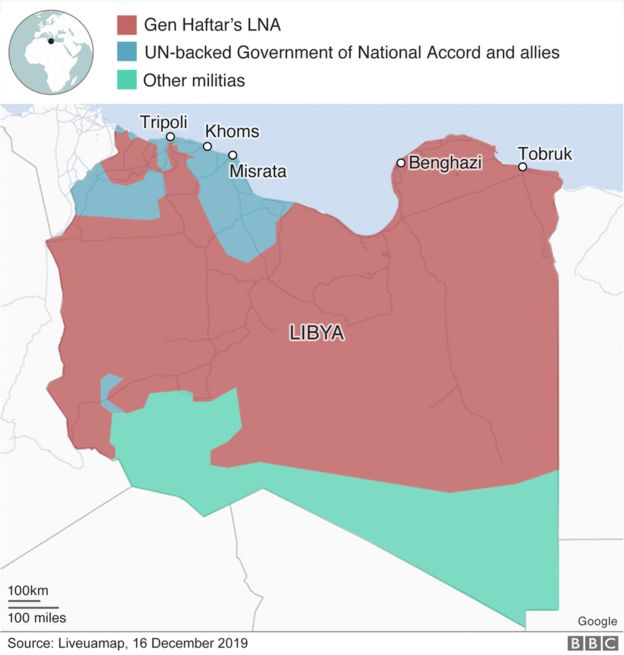
Soon after NATO hijacked the UNSC mandate to enforce a no-fly-zone decision over Libya and manipulated it in a manner that ‘legalised’ bombing Libya culminating in toppling and killing Gadhafi, the Libyan Government of National Accord (GNA), based in the formal capital of Tripoli on the Western side of the coast, was created.

But the ‘revolution’ against Gadhafi was launched in the eastern coastal city of Benghazi. After Gadhafi’s demise, another interim government was formed in Libya’s east under the name of National Transitional Council (NTC).

The NTC, whose flag is the flag of the ‘revolution’, did not recognize the GNA and regarded it as a Western lackey.

After a few years of squabbling, NTC strongman General Haftar decided to militarily disable the GNA.

With little concrete protection on the ground from the West, and under the guise of upholding UNSC mandates, Erdogan jumped into the existing void and the opportunity to grab Libya’s oil, and decided to send troops to support the GNA in January of this year. 
Map

It must be noted that even though Saudi Arabia did not attend the meeting, it was there in spirit, and represented by its proxy-partner the UAE.

The USA took a step further and accused Russia and Syria of working behind the scenes and planning to send fighters to Libya to support Haftar.

But this article is not about the geopolitical hoo-ha. It is about shedding a light on what score-settling is expected to eventuate in Libya, and who is likely to end up doing the fighting against who.

Even though the Afghani Mujahedeen were purportedly the first Jihadi fighters to engage in battle in the 20th Century, their fight was against foreign USSR troops. In terms of an internal force that aimed for fundamentalist Muslim rule, there is little doubt that the first event of such insurgency in the Middle East was the Muslim Brotherhood (MB) revolt that took place in Syria in the early 1980s and which was quashed by the then President, Hafez Assad. After their smashing defeat, the fundamentalists kept their heads low until they lit the flame again in the Palestinian refugee Naher Al-Bared Camp at the northern outskirts of Tripoli Lebanon in 2007.

There are, for those who are unaware, two cities bearing the name Tripoli on the Mediterranean coast; one is in Northern Lebanon, and it is Lebanon’s second largest city, and the other Tripoli is located on the Western side of the Libyan Coast. They are sometimes called Tripoli of the East and Tripoli of the West, respectively.

Shaker Al-Absi, leader of Fateh Al Islam, a Salafist terror organization, declared jihad and engaged in a bitter fight against the Lebanese Army. He was defeated, remained at large, but any look at Lebanon’s Tripoli after his demise displayed a clear evidence of a huge build-up of Salafist presence in the city.

When the ‘War on Syria’ started only four years later, Tripoli became a major hub for the transport of fighters and munitions from Lebanon into Syria. Nearly a decade later, and with a few Jihadi pockets left in the Idlib province now, their defeat in Syria is imminent.

But who exactly are those murderous head-chopping radical elements that we talking about; past and present?

When the coalition that started the attack on Syria took form, it was comprised virtually of all of Syria’s enemies. Most of them were religious fundamentalists. In an early article, I called them ‘The Anti-Syrian Cocktail’.  

Back then, ISIS, did not exist in the form that it became known as. Furthermore, I have always advocated that there was no difference at all between Al-Nusra and ISIS and/or any other Takfiri organizations. They are all terror-based and founded on violent readings of Islam.

In time however, and this didn’t take long, it became apparent that even though the ideologies were identical, there were two major financiers and facilitators to those many different terror organizations. One was primarily funded by Saudi Arabia and the UAE, and the other by Qatar and facilitated by Turkey.

The former group is affiliated with what is known as Saudi Wahhabi Islam. They are also known as the Salafists. The latter group are the MB’s.

As the war was shifting in favour of Syria, their agendas diverged, the schism grew deeper and strong rivalries emerged; especially as the Wahhabis and their sponsors were sent home defeated. Part of this fallout was the ongoing Saudi-Qatari conflict.

But the rivalry that is least spoken about is personal. It is the one between Erdogan and Al-Saud.

They are both fighting over the leadership of fundamentalist Sunni Islam. But Erdogan also has his nationalist anti-Kurdish agenda, and of course, he is desperate to put his hands on oil supplies that he can call his own. He cannot find oil on Turkish soil or in Turkish waters, but he is prepared to act as a regional pirate and a thug and steal another nation’s oil. If no one is to stop him, he feels that he can and will.

Upon realizing that Turkey could not get in Syria either victory or oil, Erdogan is now turning his face west towards Libya. He finds in Libya a few scores that he hopes to settle after his failure in Syria. He wants a face-saving military victory, he wants to assert his position as THE Sunni leader who can reclaim glory, and he wants free oil. Last but not least, In Libya, he will find himself close to Egypt’s Sisi; the political/religious enemy who toppled his MB friend and ally, President Mursi.

On the other side, defeated but not totally out, Saudi Arabia wants blood; Erdogan’s blood.

The Saudis blame Erdogan (and Qatar) for their loss in Syria because he was more focused on his own agenda and spoils rather than the combined ones of the former alliance they had with him. They blame him for abandoning them and making deals with Russia. They hold him responsible for the breakup of the unity of Muslim fundamentalism. They fear his aspirations for gaining the hearts and minds of Muslims who regard him as a de-facto Caliph. As a matter of fact, it was Saudi Crown Prince MBS who used the borrowed word ‘evil’ first when he stated more than two years ago that Erdogan was a part of a ‘Triangle of Evil’. And how can we forget the Khashoggi debacle and the ensuing standoff between Turkey and Saudi Arabia?

We must stop and remember once again that not long ago at all, Turkey and Saudi Arabia were allies, who together, plotted how to invade Syria and bring her down to her knees. These are the heads of the two major countries that facilitated the war machine with Saudi money injecting fighters and munitions into Syria from the south, and open Turkish borders and Qatari money injecting them from the north.

Back to Libyan General Haftar. In his westerly advance along Libya’s terrain, he cleaned up the ISIS elements who stood in his way and hindered his progress. But ironically, he is now fighting their religious rival; the Turks, the protectors of the MB’s.

The USA may accuse Syria of sending troops into Libya, but where is the proof and why should Syria do this after all? And even though the Saudis and the Emiratis are warming up relationships with Syria, the Syrian Army is still engaged in battle and is not prepared to go and fight in Libya. There is nothing for it to gain. Once the war is over, Syria will be concerned with rebuilding a war-torn nation. Syria has no interests in Libya; none what-so-ever.

The role of Russia is not very clear on the ground even though there are clear indications that Russia supports Haftar ideologically. The support began when Haftar demonstrated to the Russians that he was adamant about fighting ISIS and exterminating its presence in Libya. He lived up to this promise thus far and gained Russian respect.

How will the situation in Libya eventually pan out is anyone’s guess. That said, apart from sending regular Turkish Army units, Erdogan is not short on rounding up fighters; and he has attained much experience in this infamous field of expertise from his vicious attack on Syria. With Qatari money in his pocket, he can recruit as many fighters as Qatar can afford.

Erdogan realizes that the West is not interested in backing him up militarily in Libya. The best deal he can get from America is a tacit support. And with France, a NATO member taking part in the above-mentioned five-nation conference, he will definitely have to stand alone so-to-speak.

He has Qatar behind him, but how powerful is Qatar? A ‘nation’ of 200,000 citizens? How can such a small state play such a big role and why?

Qatar is not really a nation or even a state in the true sense. Qatar is an entity, a ‘corporation’ owned by a ruling dynasty that serves the interests of the USA and Israel. This family will outlay any sum of money to guarantee its own protection and continuity.

And Erdogan, the friend-and-foe of both of America and Israel, knows the vulnerabilities and strengths of Qatar, and he is using his deceptive talents to provide the Qatari ruling family with the securities that the shortfalls that America and Israel do not provide. For example, it was he who sent troops to Qatar after the Saudi threats. And even though Erdogan will never take any serious actions against his NATO masters except in rhetoric, the weak and fearful Qataris will dance to the tune of any protector and will sell their souls to the devil should they need to.

On the other hand in Libya, if Haftar finds himself facing a huge Turkish army, he will need assistance on the ground. Where will he seek it from?  His next-door neighbour Egypt? If so, will it be in the form of regular army units or hired guns?

Sisi is neither a religious nor a fundamentalist zealot, but this is not meant to be a complementary statement. He has not taken any serious black-and-white steps in regional politics. This does not mean he is a man of principles. He is probably waiting for dollar signs, and if he sees financial benefits in supporting Saudi Arabia in a proxy war against Turkey in Libya, he may opt to agree; if the price it right.

Whether or not Saudi Arabia can afford a new war, especially with current crude prices, is another story, but as the war on Yemen winds down, the gung-ho MBS is irrational enough to be persuaded. His regional enemy is no longer Assad. His current enemy is Erdogan.

To be fair to MBS, despite his vile, criminal and megalomaniac attributes, he never claims to be a religious leader, but Erdogan does, and many Sunni Muslims see in Erdogan THE leader they have been waiting for. This alone constitutes a huge challenge for MBS because neither he, nor anyone else in the whole of Saudi Arabia for that matter, is regarded anywhere in the Muslim World as a potential leader of the Sunni Muslims.

In reality, as far as Muslim leadership is concerned, the Saudis can only bank on the location of Mecca in Saudi Arabia. Apart from this, they only have wealth that enables them to buy supporters, but their oil wealth is becoming increasingly vulnerable.

In the uphill fight against Erdogan within the Muslim World, both of the Saudis and the Turks realize that the fight between them in Syria is over. Actually, the Saudis have no loyal ‘troops’ on Syrian soil left to fight anyone with. This begs the question of whether or not the Turks and Saudis are moving the battle ground and the score settling from Syria to Libya.

This time around, such a potential battle between the two lines of Jihadis may have to morph from a fight between terror organizations to a war between regular armies; the Turkish Army against the Egyptian Army. Such a battle will rage over Libyan soil, with the Turks financed by Qatar and Egypt by Saudi Arabia.

Such a war will not necessarily bring in Iran into the fight. If it eventuates, it will be a fundamentalist Sunni-Sunni war, sponsored by fundamentalist Sunni states, each fighting for and against different versions of radical Muslim fundamentalism, under the watchful eyes of the USA and to the glee of Israel.

The jihadi war that was first ignited in Tripoli Lebanon between a rogue terror organization and the Lebanese Army did not end. It kept moving theatres and objectives and changing players. Is the final score going to be settled in Tripoli, Libya?


THE NEW COLD WAR; THE INDUSTRIAL DEPENDENCE WAR. By Ghassan Kadi. 25 May 2020


Ghassan Kadi's thoughts on how the West got to the point it is at due to an incredible vulnerability and attitude. http://thesaker.is/the-new-cold-war-the-industrial-dependence-war/

The new cold war; The Industrial Dependence War:

By Ghassan Kadi for the Saker Blog

The world does not need a new cold war, or does it?

The Cold War started before the hot war was over. It was put into motion when America dropped the ‘bomb’ and Stalin declared that the USSR should ramp up its efforts to have this technology as soon as possible. And even though the Soviet Atomic Bomb Project was initiated in 1942, the first Soviet test was conducted in 1949, four years after Hiroshima.

The blame here is not on Stalin. After all, if Stalin did not take this ‘pre-emptive’ move, the West was planning to take him down next. It’s quite likely that Stalin and the USSR were saved from a Western invasion by the nukes they developed.

If the USA had the wisdom to learn from history, it should have realized that the moment it revealed to the rest of the world that it has a new cutting-edge super weapon, a rival will come and demand to have the same. In retrospect therefore, the ‘Manhattan Project’ was the real underlying trigger point for initiating the Cold War.

With both the US and the USSR, and later on Britain and France and other nations becoming nuclear powers, overtly or secretively, the deterring effect of a major direct confrontation between superpowers became obvious, though not strong enough to prevent major regional conventional proxy and hybrid wars all over the globe.

Nations of the Middle East together with Korea, Vietnam and many others, cannot claim any benefit from the deterring effect of the Cold War, but perhaps the USA, Europe (including Russia) and even Cuba can.

Unlike the story that the West wishes to peddle to the rest of the world, America did not win the Cold War neither did the USSR lose it. In reality, this was a negotiated agreement that happened prior to the breakup of the USSR; not afterwards.

With all the fear, tension, nuclear pollution, waste and plundering of resources that the Cold War generated, the world community has by-and-large won it with flying colours. It did stop WWIII from eventuating and definitely did not allow for more A-Bombs to be dropped on more cities after Hiroshima and Nagasaki.

Upon the breakup of the USSR, the United States had an opportunity to change direction and embark on a trajectory of demonstrating good leadership and innovation in the international community. Instead it set about promoting and installing a self-declared New-World Order that rendered the USA the sole superpower, and at all costs, ensured it stayed that way by whatever means necessary.

Nearly thirty years on, there is definitely a new cold war underway even though no one wants to give it this name. The encroachment of NATO into Eastern Europe and stationing missiles in former Warsaw Pact countries, which resulted in the development of hypersonic Russian weapons, followed by America’s unilateral cancelation of the Intermediate-Range Nuclear Forces Treaty with Russia, China’s home-built aircraft carriers, not to mention fighter jets, state-of-the art weaponry and rising tension in the South China Sea are all indicative of a new cold war irrespective what name the media and politicians want to give it.

Enter COVID-19.

I will not argue for or against the numerous theories that make different readings about its nature, scope, extent of danger and what mileage some parties are allegedly trying to achieve from it. COVID-19 however did expose a previously unseen and unspoken-about form of cold wars; the industrial dependence war.

Growing up in the Middle East in the 1960’s, I clearly remember how the then Egyptian President Nasser took great pride in industrializing Egypt. As a matter of fact, when Egypt built its car-assembly plant under license from Italian manufacturer Fiat, the brand name given to Egyptian product was Nasr; meaning victory.

On a much larger scale of course, who could forget the insatiable desire for Chairman Mao to industrialize China? I remember going to a Chinese industrial expo in Beirut in 1973. The manufacturing of heavy machinery in China was still in its infancy, but the Chinese officials manning the expo, as well as local supporters of Communist China, could not hide their broad smiles and feelings of pride and rejoice seeing the Chinese achievements.

And long before any of this, the manner in which European nations were able to conquer the rest of the world and turn it into colonies was because Europe was technologically advanced and industrialized; otherwise nations like Britain and the Netherlands would have never been able to conquer and rule much larger nations like India and Indonesia.

Presently whilst it is still a guarantee of quality to see the words ‘Made in Germany’ on a manufactured product, there was a time not long ago when similar assurance came from labels such as ‘Made in England’, or ‘Made in Great Britain’.

Isn’t this what the industrial revolution was all about, or has the world forgotten?

When Asian products began to appear in the Western markets, their quality was shockingly inferior. They were competing on price and price only. Japan took the lead, and in a short time produced high quality goods, especially in the areas of photography, sound equipment and motor vehicles; and the rest is history.

The West often ridicules ‘totalitarian regimes’ and advocates the principles of capitalism, private enterprise, and recently globalism. These principles, alongside democracy, are considered sacrosanct. Criticizing them is tantamount to blasphemy and reflects tendencies of Communism and even Fascism.

For fairness, for as long as the Western nations had viable economies that were underpinned by highly developed industrial prowess, the above doctrines proved to be successful. However, it seems that the initial efforts behind the Western rise were forgotten and that Westerners in general expect on-going success to come effortlessly.

Western manufacturers were eventually unable to compete, and many of them either closed down or moved their manufacturing base to Asia.

The model that the West developed over the last three decades or so was structured on turning its economy into one that is based on finance and service. In almost no time at all, the concept of manufacturing took a backstep and was regarded as something that only developing nations need to do in order to develop their own economies. This in fact reflects a Western covert arrogant elitist supremist vision of manufacturing as being tantamount to slavery; something that should only be done in foreign cheap labour camps. And a new type of slavery did develop indeed. Sports shoes sold in the West for $200 a pair were manufactured in sweat shops in Asia by workers paid around $2 a day.

Western industrialists were drawn to the benefits of paying for manufacturing in Yuans and Rupees and selling the goods in Green Backs. And when an imported T-shirt bought from Asia for $1 gets sold in the West for $20, it makes its own humble contribution to the national economy, and it is little wonder therefore as to why Western governments were joyful to partake in the spoils, after all, such arrangements produced high GDP’s, albeit that they were not based on actual domestic productivity.

Once again, enter COVID-19.

All of a sudden, the West found that it was crippled and unable to provide its citizens with basic hygiene necessities any faster that it could import them from China. But importation meant having to compete with other importers, and ‘begging’ suppliers for priority status, and when all failed, shipments going to other clients were confiscated and hijacked.

In an instant, the Western economic giant found itself in dire need of the manufactured goods it had considered itself too superior to produce.

Unable to produce ventilators, unable to provide facial masks for its citizens; the repercussions of the downfall of Western de-industrialization have never before been made so obvious for all to see.

And when President Trump enacted the Defense Production Act to demand that 3M should produce more masks, the production had to be done in 3M’s factories in China. How ridiculous is this!

These revelations certainly indicate that the West may not only be dependent on China for imports of the above. Certainly, this should shock the West into urgently examining the multi-faceted vulnerable position it has put itself in.

COVID-19 has exposed the West as a paper tiger with dependence on China on multiple levels. But the real questions to ask are the ones that haven’t yet surfaced.

What other vital supplies does the West depend on China for? And if the West was unable to deal with COVID-19 -related supplies in peacetime, how will it be able to deal with supplying its citizens with basic needs in wartime?

What about food security? What about pharmaceutical security?

Fleets, aircraft carriers, air-forces and off-shore military bases do not put food on the tables of citizens in wartime.

And speaking of military hardware, how do we know for certain whether or not Western military hardware does not use imported components? After all, even in peacetime, the USA buys Russian-made rockets to put satellites into orbit because it is unable to manufacture its own. But what other simple commodities is America no longer able to produce? This begs the question of what would America have to rely on for China in wartime? Socks? Blankets?

What is interesting to note here is that whilst the West was scrambling to import its needed supplies from China, almost overnight Russia was able to reach self-sufficiency and even be able to extend aid to other nations. And when Italy was expecting to receive such aid from its EU and NATO allies, those allies were too inept to even be able to look after themselves, and the aid ended up coming from Russia. Russian aid included the USA, with little appreciation from the receiver.

With free economy and free enterprise considered sacred in the dictionary of Western modus operandi, Western governments can neither fill in the missing industrial gap nor coerce private companies to do so. Will the West reflect on where they went wrong with their once successful model? Such self-examination is unlikely to happen because any Western political party that evaluates and proposes solutions to this failure will be accused of Socialism and even Fascism. One of the biggest ironies here is that Western political rivals are only interested in making political scores against each other; scores that can get them elected. They are not at all necessarily interested in what is good for their nations.

The world certainly does not need a new cold war, but the West is unknowingly deeply engaged in one already. If lessons are to be learnt is for the future to reveal. COVID-19 did not trigger a war. It did however expose the reality of an existing and on-going war, a cold war, a war no one paid much attention to before, one not based on buildup of military arsenals, but rather one of industrial dependence; a war the West has already lost to C


Sunday, May 24, 2020

THE OMINOUS JIHADIS WAR FROM TRIPOLI TO TRIPOLI By Ghassan Kadi 23 May 2020

Ghassan Kadi’s thoughts on a potentially huge situation brewing which currently barely makes the news.

The ominous Jihadis war; From Tripoli to Tripoli:

By Ghassan Kadi for the Saker Blog

The ‘War on Syria’ is far from being over, and it will continue until all foreign forces illegally present on Syrian soil retreat; either willingly, or defeated.

And even though the American presence in Syria has no clear and realistic political purpose other than wreaking havoc. https://transnational.live/2020/05/19/america-exists-today-to-make-war-how-else-do-we-interpret/ and making it hard for Russia to help reach a decisive victory, in a twist of fate, the focus of the Russo-American conflict in the region may soon move away from Syria.

In reality, the outcome of the ‘War on Syria’ was never expected by the initial assembly of adversaries when they launched the attack. Furthermore, they had many deep differences and nothing in common other than a shared hatred for Syria, but the unexpected turn of events has intensified their internal conflict and seemingly catapulted the strife between those former allies much further afield to a new hub in Libya.

Whilst the world and its media are busy with COVID-19, a new huge struggle is brewing, and this time, it is drawing new lines and objectives that are in reality going to be fueled, financed and executed by the former once-united enemies of Syria; but this time, it will be against each other.

An array of regional and international issues lies behind the impending conflict; and to call it impending is an under-statement. It is already underway, but hasn’t reached its peak yet, let alone making any significant news coverage.

It is a real mess in Libya now, and the short version of a long story goes like this:

Soon after NATO hijacked the UNSC mandate to enforce a no-fly-zone decision over Libya and manipulated it in a manner that ‘legalised’ bombing Libya culminating in toppling and killing Gadhafi, the Libyan Government of National Accord (GNA), based in the formal capital Tripoli on the Western side of the coast, was created.

But the ‘revolution’ against Gadhafi was launched in the eastern coastal city of Benghazi. After Gadhafi’s demise, another interim government was formed in Libya’s east under the name of National Transitional Council (NTC).

The NTC, whose flag is the flag of the ‘revolution’, did not recognize the GNA and regarded it as a Western lackey.

After a few years of squabbling, NTC strongman General Haftar decided to militarily disable the GNA.

With little concrete protection on the ground from the West, and under the guise of upholding UNSC mandates, Erdogan jumped into the existing void and the opportunity to grab Libya’s oil, and decided to send troops to support the GNA.  https://www.bbc.com/news/world-africa-51003034

In return, Haftar is getting support from other regional players. Recently, representatives from Egypt, the UAE, Greece, Cyprus and France had a meeting and denounced Turkey’s involvement in Libya. https://greekcitytimes.com/2020/05/12/greece-egypt-cyprus-france-uae-denounce-turkey-in-joint-statement/. Erdogan perhaps borrowed a term from his American part-ally-part-adversary and referred to the meeting and its decree as an ‘alliance of evil’. https://www.washingtonpost.com/world/national-security/turkey-accuses-five-nations-of-forming-alliance-of-evil/2020/05/12/a3c5c63a-9438-11ea-87a3-22d324235636_story.html Fancy this, a NATO member accusing other NATO members of being in an alliance of evil.

It must be noted that even though Saudi Arabia did not attend the meeting, it was there in spirit, and represented by its proxy-partner the UAE.

The USA took a step further and accused Russia and Syria of working behind the scenes and planning to send fighters to Libya to support Haftar. https://www.reuters.com/article/us-libya-security-usa-syria-idUSKBN22J301

But this article is not about the geopolitical hoo-ha. It is about shedding a light on what score-settling is expected to eventuate in Libya, and who is likely to end up doing the fighting against who.

Even though the Afghani Mujahedeen were purportedly the first Jihadi fighters to engage in battle in the 20th Century, their fight was against foreign USSR troops. In terms of an internal force that aimed for fundamentalist Muslim rule, there is little doubt that the first event of such insurgency in the Middle East was the Muslim Brotherhood (MB) revolt that took place in Syria in the early 1980’s and which was quashed by the then President, Hafez Assad. After their smashing defeat, the fundamentalists kept their heads low until they lit the flame again in the Palestinian refugee Naher Al-Bared Camp at the northern outskirts of Tripoli Lebanon in 2007.

There are, for those who are unaware, two cities bearing the name Tripoli on the Mediterranean coast; one is in Northern Lebanon, and it is Lebanon’s second largest city, and the other Tripoli is located on the Western side of the Libyan Coast. They are sometimes called Tripoli of the East and Tripoli of the West, respectively.

Shaker Al-Absi, leader of Fateh Al Islam, a Salafist terror organization, declared jihad and engaged in a bitter fight against the Lebanese Army. He was defeated, remained at large, but any look at Lebanon’s Tripoli after his demise displayed a clear evidence of a huge build-up of Salafist presence in the city.

When the ‘War on Syria’ started only four years later, Tripoli became a major hub for the transport of fighters and munitions from Lebanon into Syria. Nearly a decade later, and with a few Jihadi pockets left in the Idlib province now, their defeat in Syria is imminent.

But who exactly are those murderous head-chopping radical elements that we talking about; past and present?

When the coalition that started the attack on Syria took form, it was comprised virtually of all of Syria’s enemies. Most of them were religious fundamentalists. In an early article, I called them ‘The Anti-Syrian Cocktail’.  https://intibahwakeup.blogspot.com/2013/09/the-anti-syrian-cocktail-by-ghassan-kadi.html

Back then, ISIS, did not exist in the form that it became known as. Furthermore, I have always advocated that there was no difference at all between Al-Nusra and ISIS and/or any other Takfiri organizations. They are all terror-based and founded on violent readings of Islam.

In time however, and this didn’t take long, it became apparent that even though the ideologies were identical, there were two major financiers and facilitators to those many different terror organizations. One was primarily funded by Saudi Arabia and the UAE, and the other by Qatar and facilitated by Turkey.

The former group is affiliated with what is known as Saudi Wahhabi Islam. They are also known as the Salafists. The latter group are the MB’s.

As the war was shifting in favour of Syria, their agendas diverged, the schism grew deeper and strong rivalries emerged; especially as the Wahhabis and their sponsors were sent home defeated. Part of this fallout was the ongoing Saudi-Qatari conflict.

But the rivalry that is least spoken about is personal. It is the one between Erdogan and Al-Saud.

They are both fighting over the leadership of fundamentalist Sunni Islam. But Erdogan also has his nationalist anti-Kurdish agenda, and of course, he is desperate to put his hands on oil supplies that he can call his own. He cannot find oil on Turkish soil or in Turkish waters, but he is prepared to act as a regional pirate and a thug and steal another nation’s oil. If no one is to stop him, he feels that he can and will.

Upon realizing that Turkey could not get in Syria either victory or oil, Erdogan is now turning his face west towards Libya. He finds in Libya a few scores that he hopes to settle after his failure in Syria. He wants a face-saving military victory, he wants to assert his position as THE Sunni leader who can reclaim glory, and he wants free oil. Last but not least, In Libya, he will find himself close to Egypt’s Sisi; the political/religious enemy who toppled his MB friend and ally, President Mursi.

On the other side, defeated but not totally out, Saudi Arabia wants blood; Erdogan’s blood.

The Saudis blame Erdogan (and Qatar) for their loss in Syria because he was more focused on his own agenda and spoils rather than the combined ones of the former alliance they had with him. They blame him for abandoning them and making deals with Russia. They hold him responsible for the breakup of the unity of Muslim fundamentalism. They fear his aspirations for gaining the hearts and minds of Muslims who regard him as a de-facto Caliph. As a matter of fact, it was Saudi Crown Prince MBS who used the borrowed word ‘evil’ first when he stated more than two years ago that Erdogan was a part of a ‘Triangle of Evil’. https://www.reuters.com/article/us-saudi-turkey-idUSKCN1GJ1WW. And how can we forget the Khashoggi debacle and the ensuing standoff between Turkey and Saudi Arabia?

We must stop and remember once again that not long ago at all, Turkey and Saudi Arabia were allies, who together, plotted how to invade Syria and bring her down to her knees. These are the heads of the two major countries that facilitated the war machine with Saudi money injecting fighters and munitions into Syria from the south, and open Turkish borders and Qatari money injecting them from the north.

Back to Libyan General Haftar. In his westerly advance along Libya’s terrain, he cleaned up the ISIS elements who stood in his way and hindered his progress.  https://www.theguardian.com/commentisfree/2020/feb/02/libya-foreign-powers-khalifa-haftar-emirates-russia-us But ironically, he is now fighting their religious rival; the Turks, the protectors of the MB’s.

The USA may accuse Syria of sending troops into Libya, but where is the proof and why should Syria do this after all? And even though the Saudis and the Emiratis are warming up relationships with Syria, the Syrian Army is still engaged in battle and is not prepared to go and fight in Libya. There is nothing for it to gain. Once the war is over, Syria will be concerned with rebuilding a war-torn nation. Syria has no interests in Libya; none what-so-ever.

The role of Russia is not very clear on the ground even though there are clear indications that Russia supports Haftar ideologically. The support began when Haftar demonstrated to the Russians that he was adamant about fighting ISIS and exterminating its presence in Libya. He lived up to this promise thus far and gained Russian respect.

How will the situation in Libya eventually pan out is anyone’s guess. That said, apart from sending regular Turkish Army units, Erdogan is not short on rounding up fighters; and he has attained much experience in this infamous field of expertise from his vicious attack on Syria. With Qatari money in his pocket, he can recruit as many fighters as Qatar can afford.

Erdogan realizes that the West is not interested in backing him up militarily in Libya. The best deal he can get from America is a tacit support. And with France, a NATO member taking part in the above-mentioned five-nation conference, he will definitely have to stand alone so-to-speak.

He has Qatar behind him, but how powerful is Qatar? A ‘nation’ of 200,000 citizens? How can such a small state play such a big role and why?

Qatar is not really a nation or even a state in the true sense. Qatar is an entity, a ‘corporation’ owned by a ruling dynasty that serves the interests of the USA and Israel. https://thesaker.is/qatar-unplugged/. This family will outlay any sum of money to guarantee its own protection and continuity.

And Erdogan, the friend-and-foe of both of America and Israel, knows the vulnerabilities and strengths of Qatar, and he is using his deceptive talents to provide the Qatari ruling family with the securities that the shortfalls that America and Israel do not provide. For example, it was he who sent troops to Qatar after the Saudi threats. And even though Erdogan will never take any serious actions against his NATO masters except in rhetoric, the weak and fearful Qataris will dance to the tune of any protector and will sell their souls to the devil should they need to.

On the other hand in Libya, if Haftar finds himself facing a huge Turkish army, he will need assistance on the ground. Where will he seek it from?  His next-door neighbour Egypt? If so, will it be in the form of regular army units or hired guns?

Sisi is neither a religious nor a fundamentalist zealot, but this is not meant to be a complementary statement. He has not taken any serious black-and-white steps in regional politics. This does not mean he is a man of principles. He is probably waiting for dollar signs, and if he sees financial benefits in supporting Saudi Arabia in a proxy war against Turkey in Libya, he may opt to agree; if the price it right.

Whether or not Saudi Arabia can afford a new war, especially with current crude prices, is another story, but as the war on Yemen winds down, the gung-ho MBS is irrational enough to be persuaded. His regional enemy is no longer Assad. His current enemy is Erdogan.

To be fair to MBS, despite his vile, criminal and megalomaniac attributes, he never claims to be a religious leader, but Erdogan does, and many Sunni Muslims see in Erdogan THE leader they have been waiting for. This alone constitutes a huge challenge for MBS because neither he, nor anyone else in the whole of Saudi Arabia for that matter, is regarded anywhere in the Muslim World as a potential leader of the Sunni Muslims.

In reality, as far as Muslim leadership is concerned, the Saudis can only bank on the location of Mecca in Saudi Arabia. Apart from this, they only have wealth that enables them to buy supporters, but their oil wealth is becoming increasingly vulnerable.

In the uphill fight against Erdogan within the Muslim World, both of the Saudis and the Turks realize that the fight between them in Syria is over. Actually, the Saudis have no loyal ‘troops’ on Syrian soil left to fight anyone with. This begs the question of whether or not the Turks and Saudis are moving the battle ground and the score settling from Syria to Libya.

This time around, such a potential battle between the two lines of Jihadis may have to morph from a fight between terror organizations to a war between regular armies; the Turkish Army against the Egyptian Army. Such a battle will rage over Libyan soil, with the Turks financed by Qatar and Egypt by Saudi Arabia.

Such a war will not necessarily bring in Iran into the fight. If it eventuates, it will be a fundamentalist Sunni-Sunni war, sponsored by fundamentalist Sunni states, each fighting for and against different versions of radical Muslim fundamentalism, under the watchful eyes of the USA and to the glee of Israel.

The jihadi war that was first ignited in Tripoli Lebanon between a rogue terror organization and the Lebanese Army did not end. It kept moving theatres and objectives and changing players. Is the final score going to be settled in Tripoli Libya?